 EN

Locate the tangle before choosing a solution
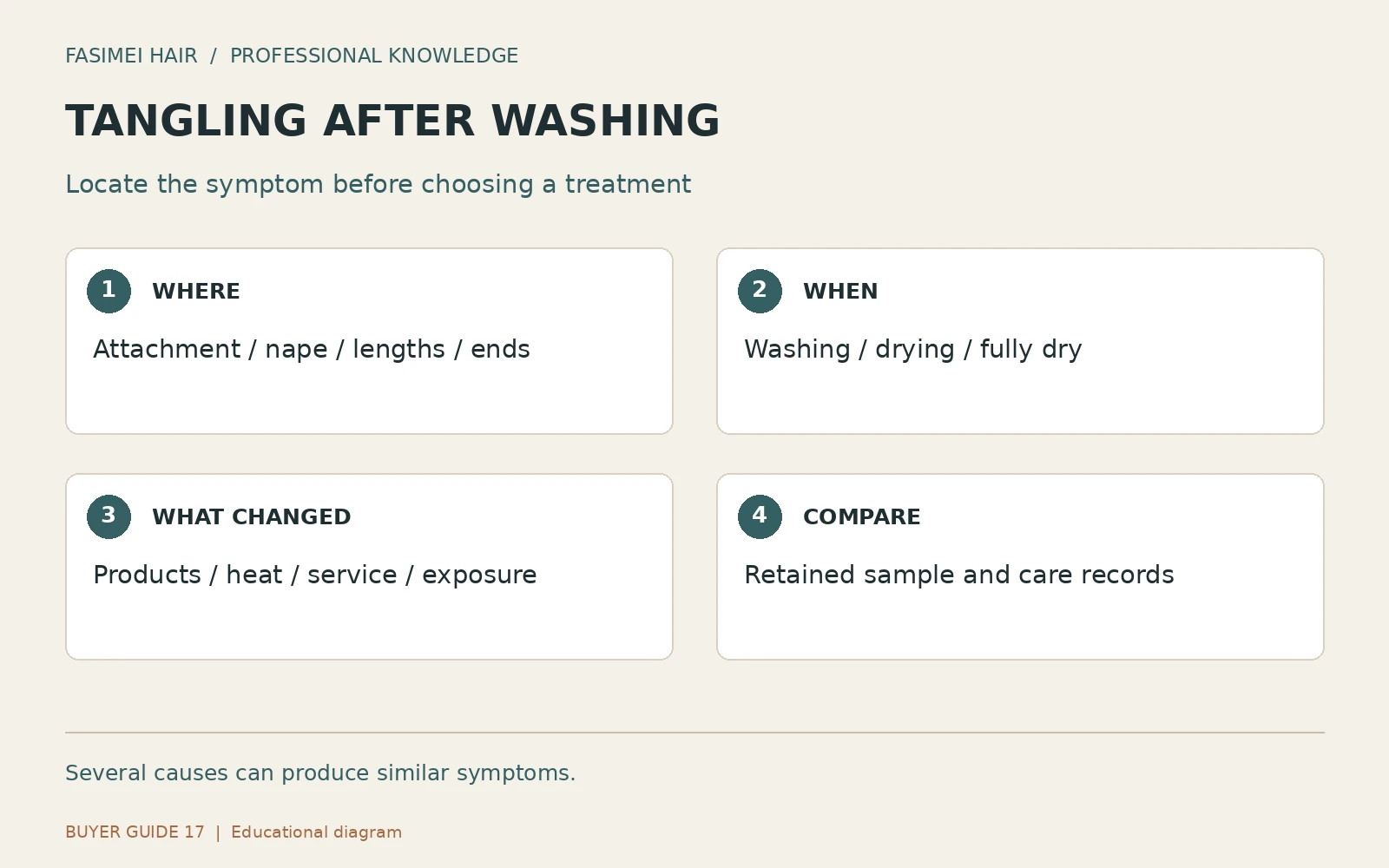
Hair extensions that tangle after washing need a structured assessment, not an immediate conclusion that the hair is fake or the client is careless. Start by identifying where the tangle forms: at the attachments, through the middle, at the nape or mainly at the ends. Record whether it appears while shampooing, during drying or after the hair is fully dry.
These observations narrow the questions. A compact knot near a grown-out attachment calls for a different inspection from ends that feel rough across an entire loose sample. Neither location alone proves the cause. Avoid pulling apart a severe knot for a demonstration; additional force can break strands and obscure the original condition.
Review what happened during washing
Ask the client to describe the routine in sequence. Record the shampoo and conditioner, application areas, water temperature, washing position, rubbing motions, rinsing and drying method. “I used salon shampoo” is not a reproducible description. Obtain the actual product names and note any recent change.
Hair piled or rubbed together can become difficult to separate. Heavy residue or insufficient rinsing may also complicate handling. Follow the installer’s method-specific instructions rather than giving one washing rule for every attachment. Do not recommend stronger cleansing as the default response: a clarifier appropriate for one situation may be unsuitable for another product or for the attachment area.
Separate hair condition from installation condition
Inspect attachment spacing, growth, separation between rows or strands, and the surrounding natural hair. A qualified stylist should check whether neighboring attachments have become entangled or whether the installation requires maintenance. Persistent pulling or scalp discomfort should be assessed promptly, not treated as a normal feature of extensions.
For loose sample hair, inspect handling and fiber condition separately from the installed system. Review processing history and compare with an unused retained sample where available. Photos of shiny hair before washing cannot establish long-term performance. Likewise, a tangle after one wash does not identify whether raw material, processing, attachment construction or handling was responsible.
Check exposures without blaming one ingredient
Ask about heat, recent toning, purple shampoo, pool or sea water, sunscreen, fragrance and products transferred from the body or clothing. Record whether the problem began after a particular event. The timing is useful evidence, but it is not a controlled experiment.
Fasimei advises clients to keep perfume away from extension hair. The guide to perfume on hair extensions explains that precaution and the limits of attributing a problem to fragrance alone. Avoid social-media diagnoses such as “all tangling means reversed cuticles.” Several issues can produce similar symptoms, and cuticle condition cannot reliably be established from a phone photograph of a knot.
Make a fair comparison before a bulk decision
For a buyer evaluating samples, use comparable pieces and keep wash products, amounts, handling and drying consistent. Label every sample and take notes before, during and after washing. Do not compare a freshly conditioned sample from one supplier with a heavily styled piece from another.
Use a hair extension product specification sheet to record what was ordered and how it will be evaluated. Keep an unused reference when practical. A small sample can identify a concern for further investigation; it cannot prove the performance of every unit in a future order. Agree with the supplier on the review and sampling process before expanding the purchase.
Resolve the problem with evidence
For an installed client, the next step may be a professional detangling or maintenance appointment. For a wholesale delivery, it may be an inspection of affected pieces and retained references. Preserve the current condition before experimenting with products intended to “repair” the hair.
Record affected quantity, batch identifiers, care history and consistent photographs using how to document a hair extension quality complaint. Tell the supplier what changed and what resolution you are requesting. If you are setting a purchasing or care protocol, discuss your product requirements with Fasimei so sample evaluation and client instructions address the same intended use.
Frequently Asked Questions
Does tangling prove the hair is non-Remy?
No. Tangling is a symptom with several possible causes; a label or a photograph is not a sufficient diagnosis.
Should I keep brushing until a knot comes out?
No. Stop forceful brushing and ask a qualified stylist to assess severe tangles and attachment condition.
Can conditioner solve every washing problem?
No. It cannot correct installation issues or establish the cause of damaged or altered hair.