 EN


Choose a service before choosing a large catalog
A private-label pilot should answer whether a defined product can support the service your business intends to sell. It should not begin with every available method, length and color. A focused scope makes feedback easier to interpret and reduces the number of variables you must approve at once.
Start with the salons or stylists who will use the range, their existing skills and the client needs they can describe. Identify one priority service and its required product characteristics. A beautiful logo does not resolve unclear hair specifications, and a large color list does not establish demand. Write down what the pilot needs to demonstrate before placing the order.
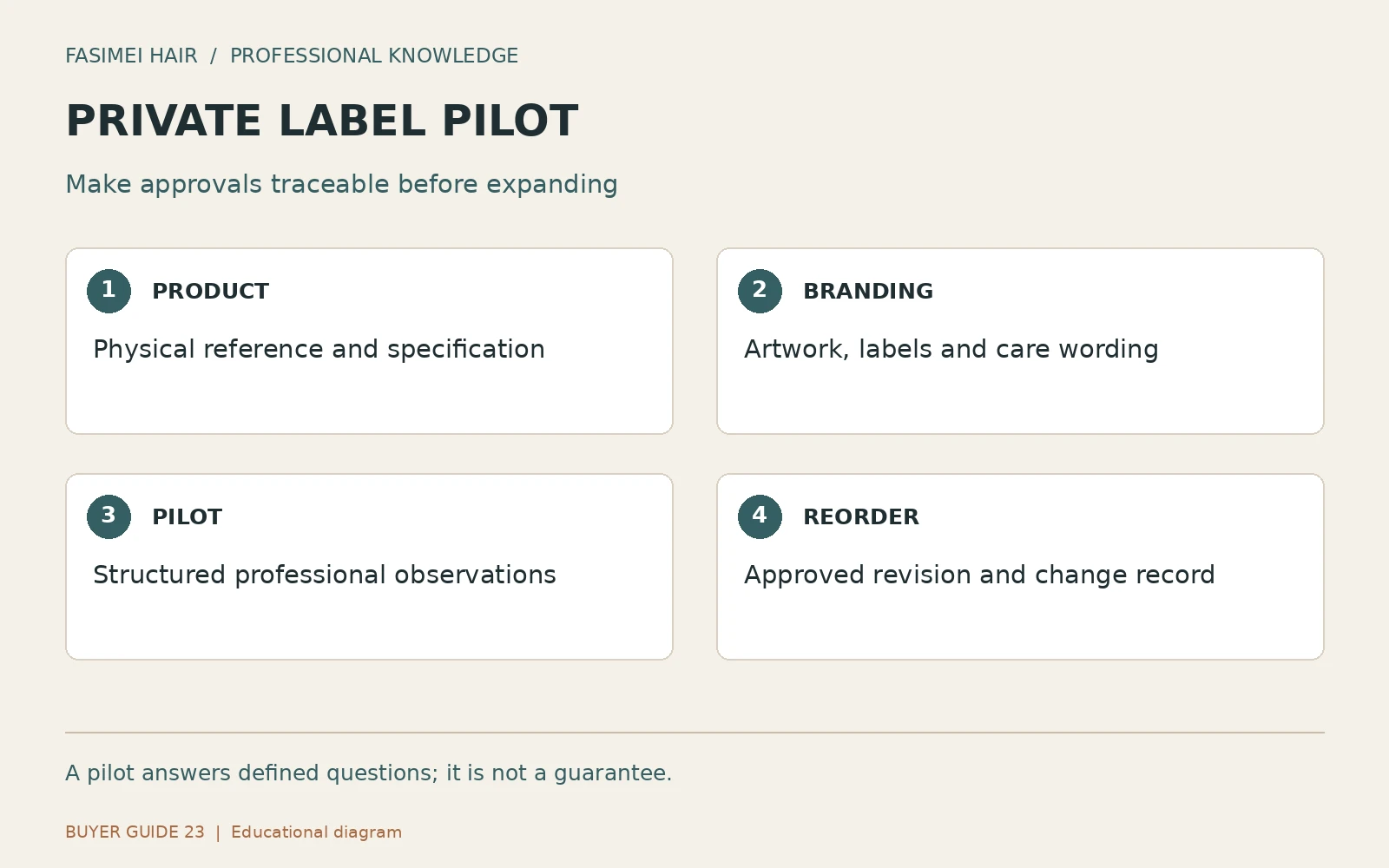
Separate product approval from branding approval
Approve the hair and attachment construction independently of packaging artwork. Record length, weight, color, ends, dimensions and professional instructions in a hair extension product specification sheet. Retain a labeled physical reference instead of using an edited catalog photo as the master standard.
For the brand side, check logo files, print size, color references, labels and care wording. Make sure claims match evidence and the actual product. Do not describe colored hair as completely unprocessed, imply geographic origin without verification or add universal wear-time guarantees. Ask for an updated proof when artwork changes rather than treating an earlier approval as blanket permission.
Make the pilot conditions explicit
Ask for the current sample and production quantities, commercial terms, lead-time basis and available packaging options. Do not assume that custom packaging and hair production have the same minimum order or schedule. Agree what approval starts each stage.
Identify who may request changes and how a revision will be recorded. If a shade or attachment changes after the sample is approved, decide whether another reference is needed before production. Confirm which components can be reordered independently. A pilot is useful only if the approved result can be identified again when you need replenishment, maintenance components or a customer review.
Collect structured professional feedback
Choose participating professionals who understand the method and can follow the product instructions. Give them a consistent record for opening inspection, fitting, care and follow-up observations. Tell them what has and has not been established by the initial sample.
Separate the client’s feedback from the installer’s observations and retain dates. If there is a concern, record it before corrective coloring or other alterations. Review how to document a hair extension quality complaint for the evidence structure. A few positive comments do not prove universal performance, just as one report does not automatically establish the scope or cause of a batch problem.
Decide what must change before expansion
Review whether the pilot met the product specification, professional handling requirements and intended client result. Check practical issues such as pack labeling, consultation clarity and reorder identification. Record changes with priorities and owners instead of sending an unsorted list of impressions to the supplier.
Keep commercial learning separate from technical approval. Poor sales do not necessarily mean poor hair; the offer, service capacity and market fit may need work. Conversely, strong launch interest does not remove the need to address a technical issue. Expand only when the specific questions that justified the pilot have clear answers.
Build a repeatable next order
Document the approved revision, physical references, packaging files and care instructions together. Use how to keep hair extension quality consistent across repeat orders to set up the next purchasing discussion. Keep original and revised approvals distinguishable so an old file does not return to production accidentally.
Set a review point for the next order rather than promising immediate large-scale growth. To explore product methods, current sample options and private-label packaging for your intended service, discuss your product requirements with Fasimei. Begin with the range you can evaluate and support professionally, then expand based on evidence from your own customers.
Frequently Asked Questions
Should a pilot include every color?
Not necessarily. Choose a scope that answers a defined commercial and technical question.
Does a packaging proof approve the hair?
No. Product, color and branding approvals should be recorded separately and linked to the order.
Can a successful pilot guarantee future batches?
No. Reorders still need a clear specification, revision control and agreed inspection process.